OLED & Aliens: An Analysis of iPhone Screens
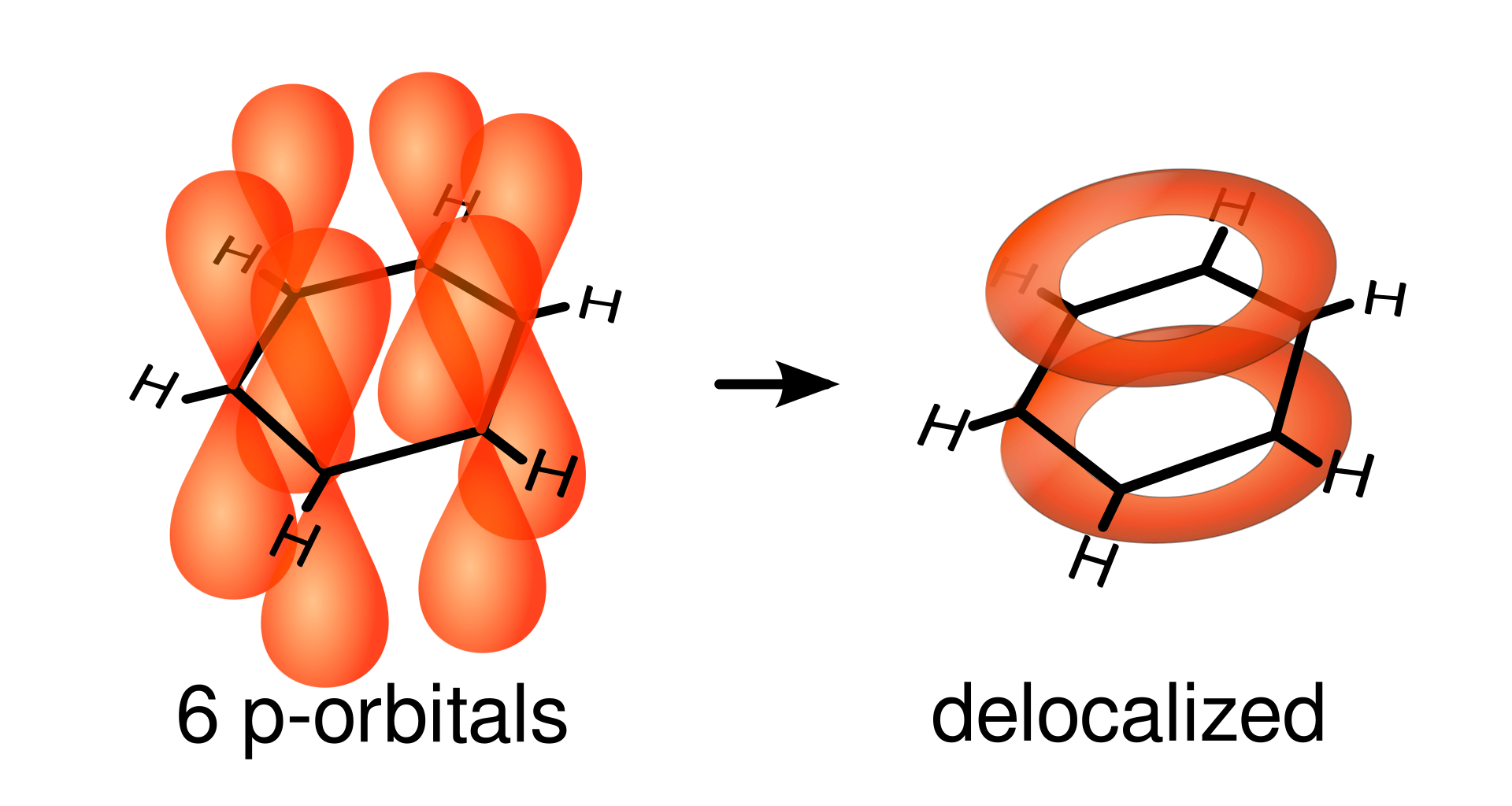
I once recently had a dream in which I became embroiled in an encounter with hostile aliens. The aliens were seeking a highly coveted technology I had created in secret: a tiny, advanced computer. The computer operated on the principle that transistors were composed not of silicon, but of organic molecules - each transistor was a singular arene molecule. The logic was that each arene molecule (possessing a conjugated structure) could use the delocalised $\pi$-electron clouds above and below the plane of the molecule to conduct electricity. Depending on several factors like applied electric/magnetic fields and substituents on the carbon ring, the electronegativity, and hence the conductivity of the molecule, could be tweaked, and so the molecule itself could act as a semiconductor.
This was the next big step in transistor miniaturisation. In my dream, the aliens could not reproduce this because the synthesis mechanism of the particular arene compound I used had great energy barriers - energy barriers I had only overcome because I had previously (also in the timeline of the dream) created an antimatter reactor, which slammed antimatter particles into a coiled Osmium strip (my dream specified that Osmium must be used, since it’s the densest naturally occurring element and hence would last the longest, because it packed the most atoms in the same volume), releasing great amounts of energy, which was the only reason I could synthesise this particular arene. The whole “combo” of the reactor and computer was fitted into a single spherical device - the back half contained the gaseous/liquid arene stored in a carbon steel compartment, and the front half had the antimatter reactor, with a zircon window in the centre which would let light from the inner reactor through - Iron Man, arc reactor style. I distinctly remember the whole device to be a sphere - which had the ability to transform into a solid, homogenous hunk of metal if it ever fell into the wrong hands, revealing nothing about the internal circuitry (straight out of Isaac Asimov’s Foundation and the “atomics” depicted in it).
Imagine my surprise, when a few days later, I found out that in principle, OLED displays work exactly the same way - they use organic semiconductors which are electrically conductive because the delocalisation of $\pi$-electrons caused by conjugation! What a dream (of course, there’s the possibility that this encounter actually happened, and the aliens tried to scrub my memory, but partially failed).
I began researching displays when I noticed a thin black line creeping across the screen of my iPhone 11. It quickly spread across the whole width, and then gradually began becoming thicker. With mounting concern, I promptly placed the device under the microscope, and began investigating possible causes.
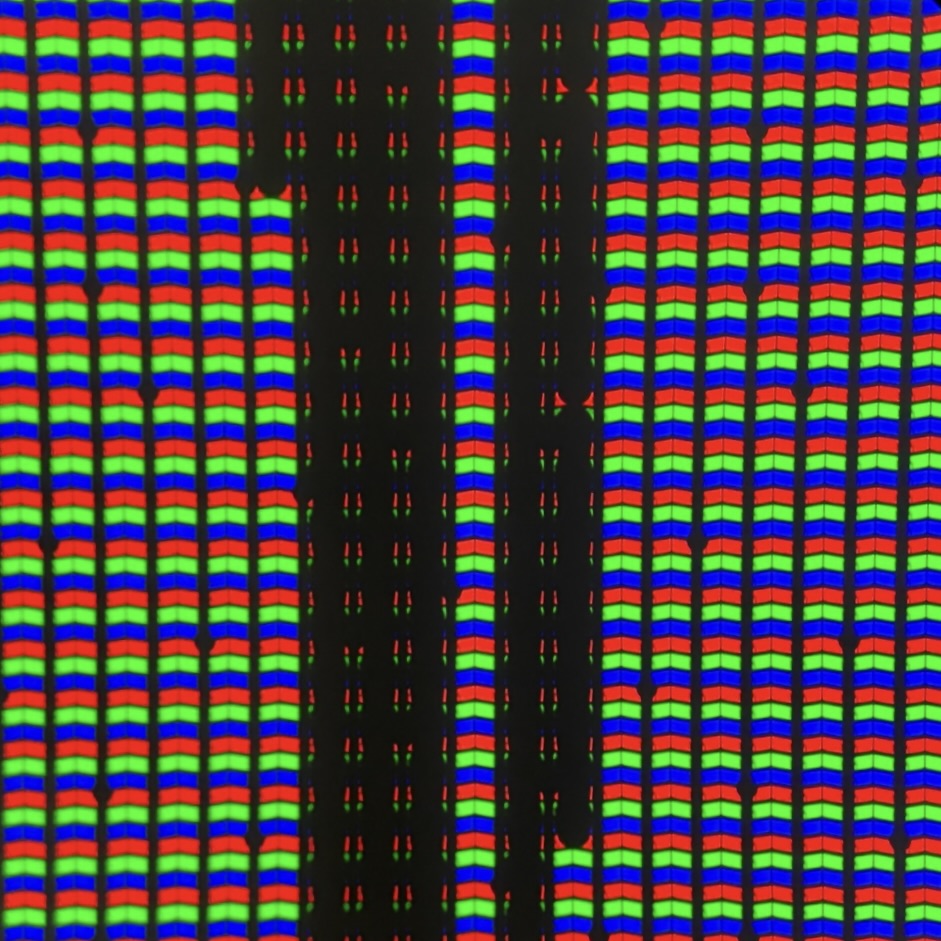
In previous years, I had already placed my phone under the microscope, and I knew what to expect. The familiar, regular arrangement of RGB sub-pixels blurred into view as I adjusted the focus. There were distinct, blackish lines visible under the microscope at a particular location: entire rows of pixels were (almost) not letting any light through. Between these lines, I could just see tiny specs of coloured light, which were struggling to get past what seemed to be a dark layer on top.
Research revealed that LCDs operate using an LED backlight and liquid crystal molecules which are optically active. The screen uses a uniform, white backlight, which coloured RGB filters on top, which are used to create individual R, G and B sub-pixels.
The liquid crystal is optically active, meaning it rotates plane-polarised light and acts as an analyser (the backlight itself being polarised already). Depending on the voltage supplied to the liquid crystal molecules by means of tiny Indium-Tin “nanowires”, the crystal molecules “twist” or untwist, rotating the analyser linked to that specific sub-pixel a certain amount. By Malus’s law, this influences the light intensity transmitted through: $$I=I_0\cos^2(\theta)$$ where $I$ is the transmitted intensity, $I_0$ is the incident intensity (the light from the LED backlight), and $\theta$ is the angle of the analyser relative to the polariser.
Based on this, it would seem that for the pixels with the black lines, the liquid crystal molecules are permanently stuck in a state such that the analyser is at right angles to the polariser, making the transmitted intensity 0 ($I=I_0\cos^2(90º)=I_0\cdot 0=0$).
There could be multiple causes for this. It is possible that the In-Sn wires in that region have broken, so voltage is not being supplied properly to that region, in which case the display must simply be replaced - there is no other solution. Or it is possible that the liquid crystal in that region has mere accumulated and “agglutinated”. Something like this can possibly be repaired by using certain tools such as “pixel refreshers” available online on websites. These tools rapidly flash colours on and off on the screen at the pixel level. On a macroscopic level, these look like RGB visual static. The rapid changes can serve to dislodge stubborn, stuck liquid crystal.
My hope fading (since such “dead” pixels can rarely be repaired, and are due to un-fixable hardware faults, such as the broken nanowires), I decided to try using a pixel refresher and see if anything happens. The website jscreenfix.com ran on my phone for at least an hour, but there was no observable change (even under the microscope!) and I decided that I would not be able to fix my iPhone display.
A slo-mo (4X) of an iPhone 11 display under 100X magnification. The iPhone is playing a pixel refresher from jscreenfix.com. The two lines in the centre are dead pixels.
However, I was still having fun with and exploring my new microscope (the Magnus MLXi Plus), so I proceeded to view the next generation of iPhone in my household (the iPhone 16 Pro) under the microscope. Apple keeps coming up with fancy new lingo to describe their displays, so surely there’d be something different visible, and some evolution in the display technology.
I was quite surprised to see a gorgeous, extremely sharp, and visually very different display. In this time, Apple switched from LCD displays to OLED displays - what they call “Super Retina XDR”.
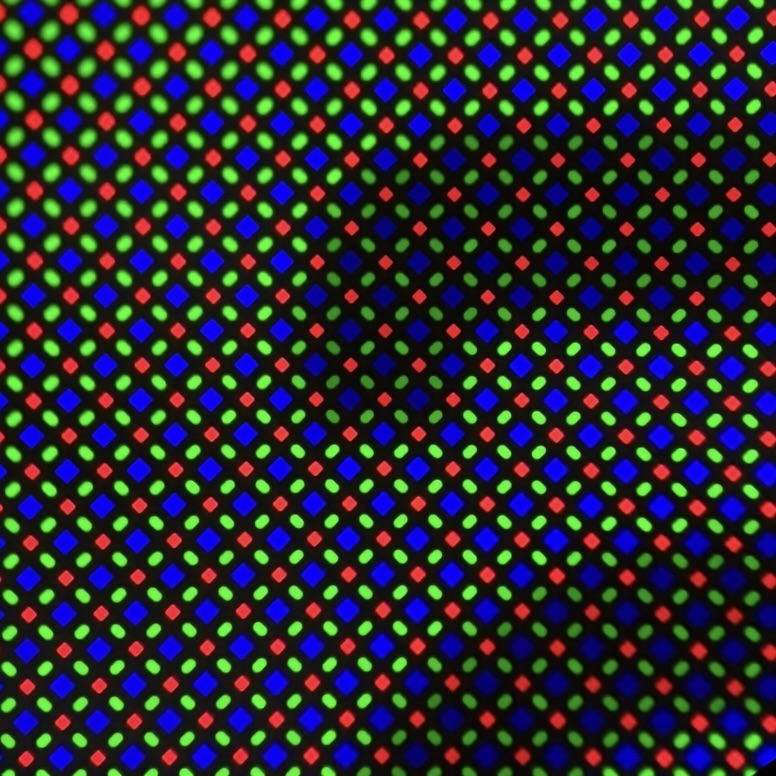
OLED has now overtaken LCD as the gold-standard display technology. And the first micrograph (Fig. 1) actually shows one of the reasons why - even with the dead pixels, some light leaks through the liquid crystal layer, which means that true blacks don’t exist: the LED backlight is always on. In OLED technology, each individual sub-pixel can actually turn off, creating true blacks, and hence “infinite” contrast (the white:black intensity ratio is infinite, since one must divide by 0).
Is OLED the stepping stone to a first encounter with extra-terrestrials? If they drop by, I’ll be sure to let the world know.