Synthesis of Iron(III) Chloride
I prepared Iron(III) Chloride solution using solid iron, hydrochloric acid and hydrogen peroxide. The actual concentration of the solution is yet to be determined.
Several iron nails were dissolved in 50cm$^3$ 4.34M HCl. I did not measure the mass of the iron nails, since the nails had small but visible amounts of rust. Instead, enough iron was added so that eventually, some iron was left unreacted. Thus the HCl (of known volume and concentration) was the limiting reagent.
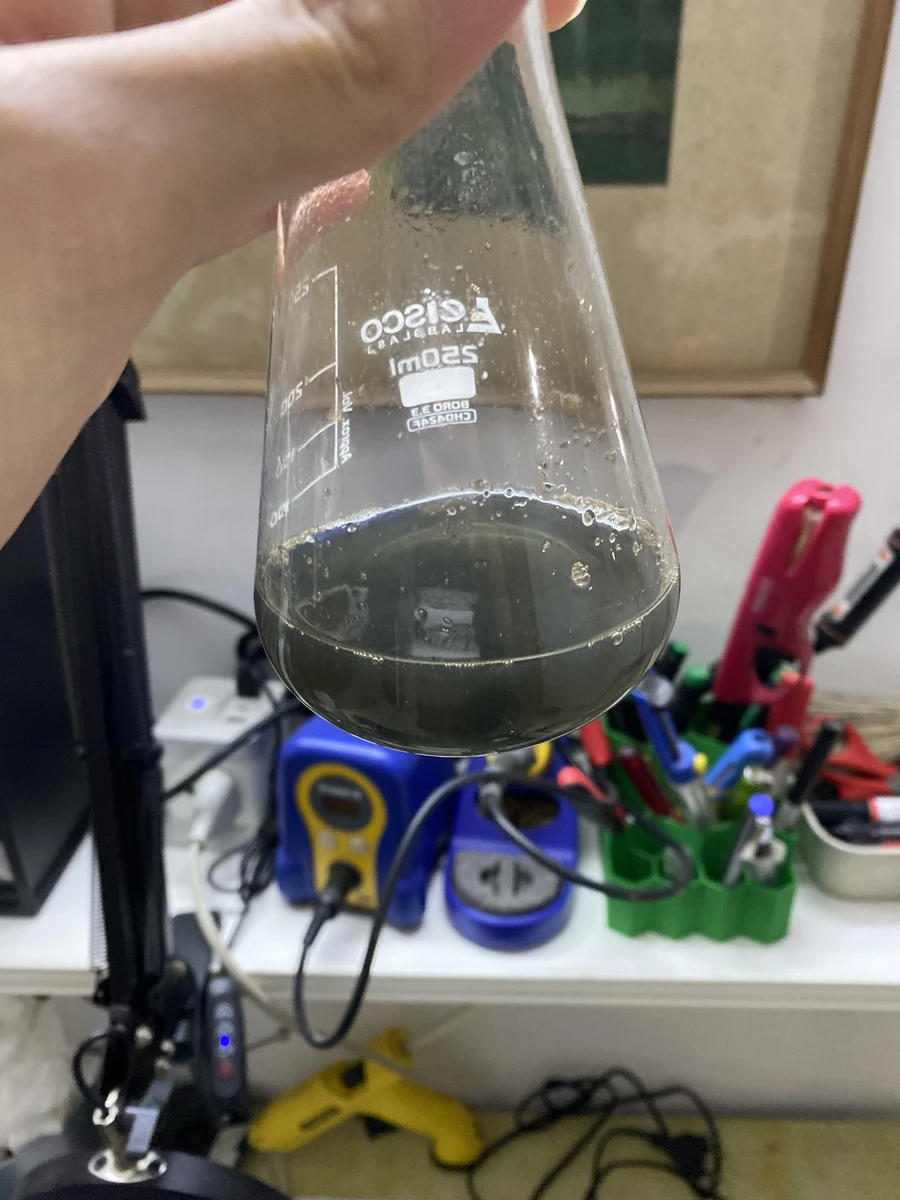
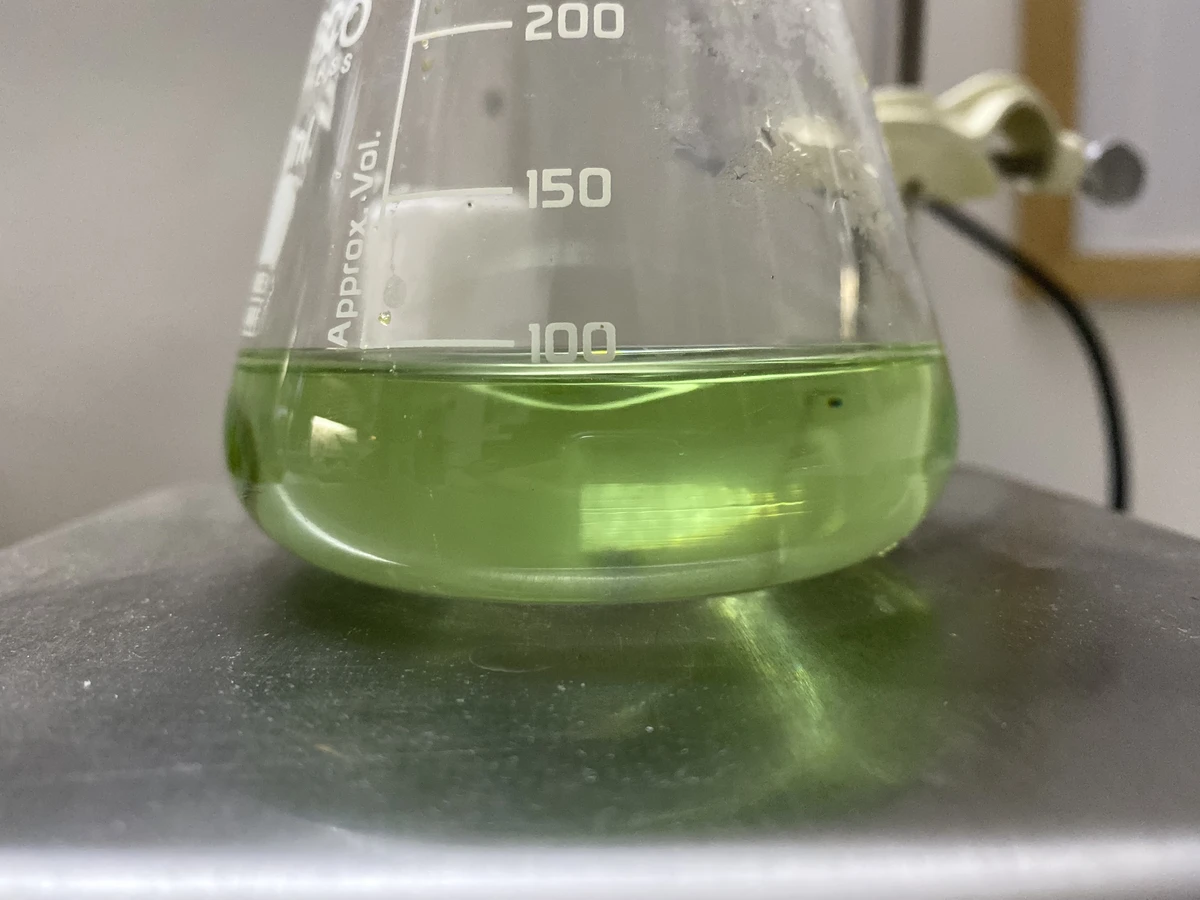
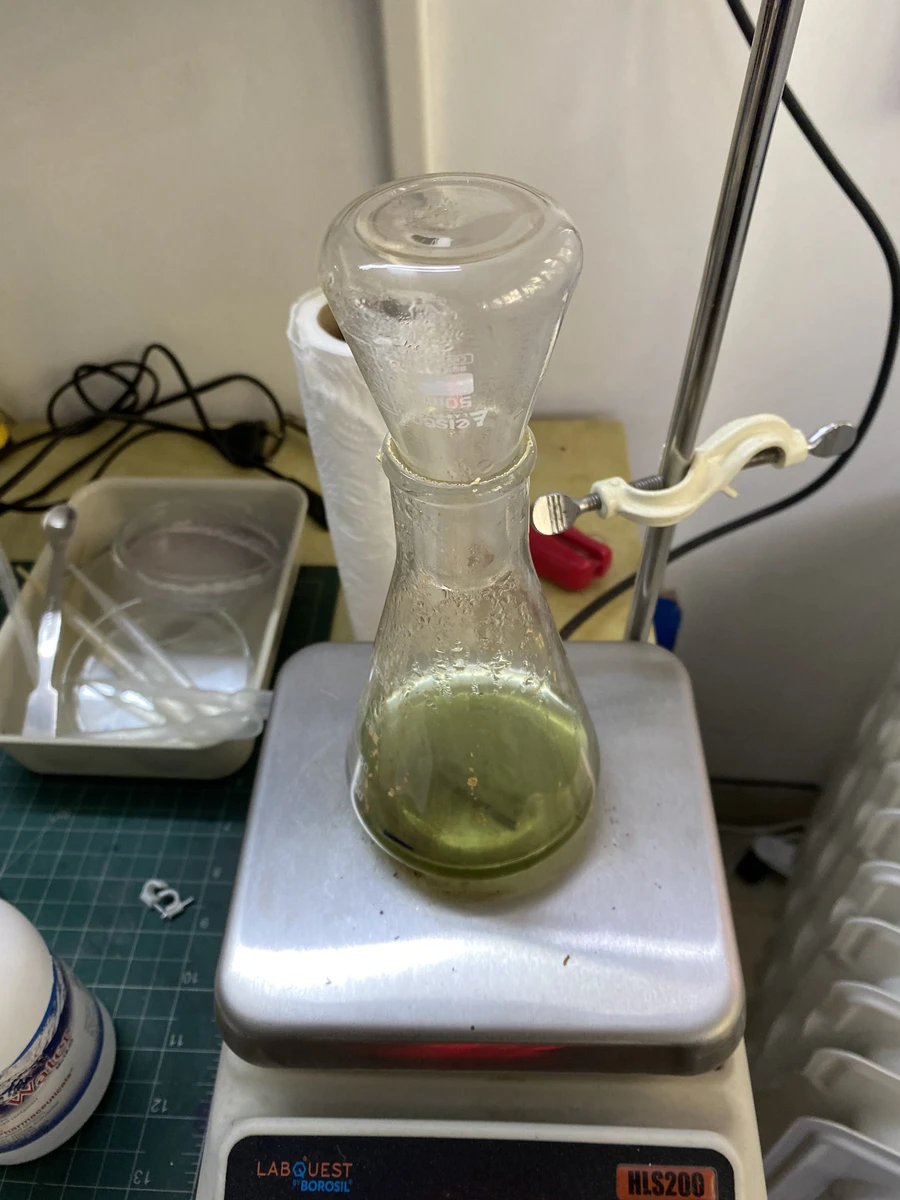
The balanced chemical equation for the reaction is:
$$Fe_{(s)} + 2HCl_{(aq)}\rightarrow FeCl_{2(aq)} + H_{2(g)}$$
Since the HCl was the limiting reagent, we can approximate the amount of FeCl$_2$ produced:
$$ \begin{equation} n_{HCl}=\frac{V_{HCl}}{1000}\cdot M_{HCl} \end{equation} $$
$$\Rightarrow n_{HCl}=\frac{50}{1000}\cdot 4.34$$
$$\Rightarrow n_{HCl}=0.217 mol$$
$$n_{FeCl_2}=\frac{1}{2}\cdot n_{HCl}$$
$$\Rightarrow n_{FeCl_2}=0.1085 mol$$
$$\Rightarrow n_{FeCl_2}=0.11 mol$$
The Iron(II) Chloride was then oxidised (in the presence of excess HCl to prevent the formation of insoluble Iron(III) Hydroxide) using 6.3% Hydrogen Peroxide solution to form Iron(III) Chloride solution.
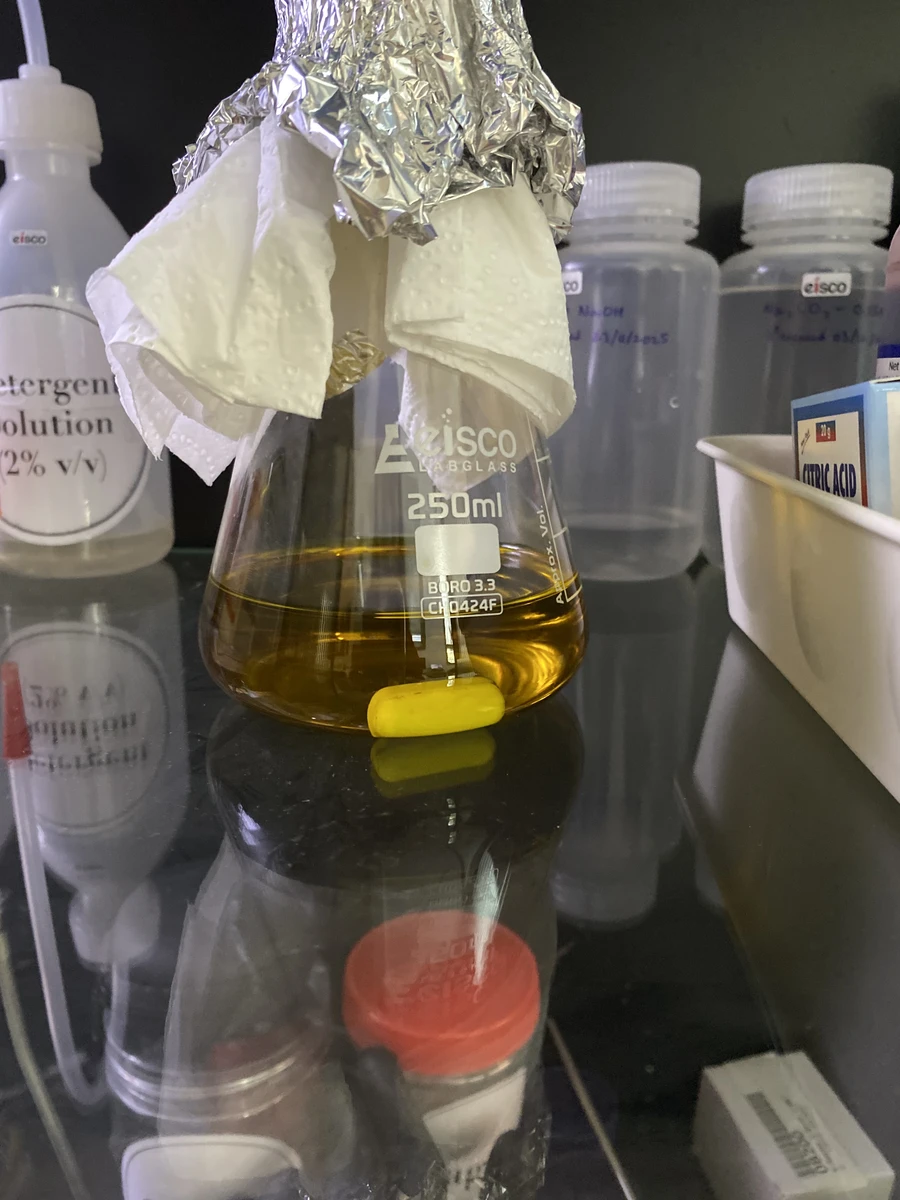
The balanced chemical equation for the reaction is:
$$2FeCl_{2(aq)} + 2HCl_{(aq)} + H_2O_2 \rightarrow 2FeCl_{3(aq)} + 2H_2O_{(l)}$$
Using the earlier calculations, we can approximate the amount of FeCl$_3$ formed:
$$n_{FeCl_3}=n_{FeCl_2}$$
$$\Rightarrow n_{FeCl_3}=0.11 mol$$
However, due to accidental spillage during the process and impurities in the iron, this is very probably not close to the actual value. Therefore, an accurate estimate of the actual concentration will be determined experimentally in the future.